
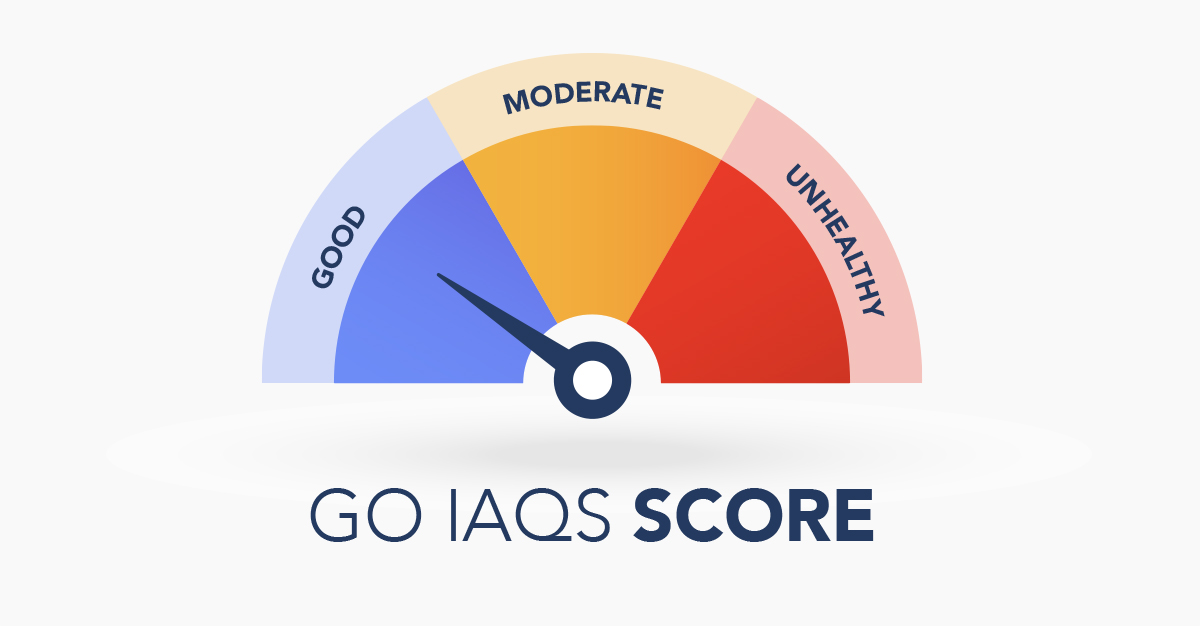
The GO IAQS Score, also known as the Indoor Air Quality Index (IAQI), is a critical measurement system developed by GO AQS to translate complex indoor air pollution data into a user-friendly score. It consolidates measurements of various pollutants, including gases and particulate matter, into a single, intuitive value ranging from 10 (Good) to 0 (Unhealthy). Crucially, the GO IAQS Score is a single-tier scoring system; although the underlying GO IAQS Starter and Ultimate standards use different limits, the latter feeds into this unified 10-point scale for public real-time communication. The scientific community emphasizes that for air quality communication to be effective for the public and policymakers, indices must be both simple and comprehensive.
The GO IAQS Score is primarily designed for real-time protection and immediate occupant awareness, utilizing breakpoints tailored for rapid assessment rather than relying on the time-averaged limits set in the GO IAQS Starter or GO IAQS Ultimate tiers. This independence allows the Score to provide a dynamic, moment-to-moment picture of air quality. However, a crucial point of cohesion exists: the lower limits for the “Good” tier of the Score are directly established by the GO IAQS Ultimate threshold values for CO2, CH2O, and Rn. Due to the difficulty in reliably deriving rapid, protective breakpoints from multi-hour time-averaged limits (e.g., converting an annual limit to a 24-hour one) the IAQ Index employs breakpoints that are immediately meaningful for the occupants. While the real-time Score informs users, automatic notifications and official IAQ Reports are exclusively based on surpassing the specified time-averaged (1-hour, 8-hour, or 24-hour) limits or thresholds limits defined within the Starter or Ultimate tiers—for example, a user would receive a report only after the 1-hour average for a pollutant like PM2.5 exceeds its set limit (e.g., 15μg/m3).
While existing national and organizational AQI scales vary, creating confusion, the GO IAQS Score addresses this by proposing a unified, streamlined approach. It features a simplified 3-breakpoint AQI that integrates the strengths of indices like the US EPA, the South Korean CAI, and the EU EAQI. Many custom AQIs attempt to tackle complexity but often confuse users with numerous breakpoints and hard-to-differentiate color ranges. The GO IAQS Score, by contrast, offers a more realistic and user-friendly color scheme with fewer divisions, making it easier to understand and remember.
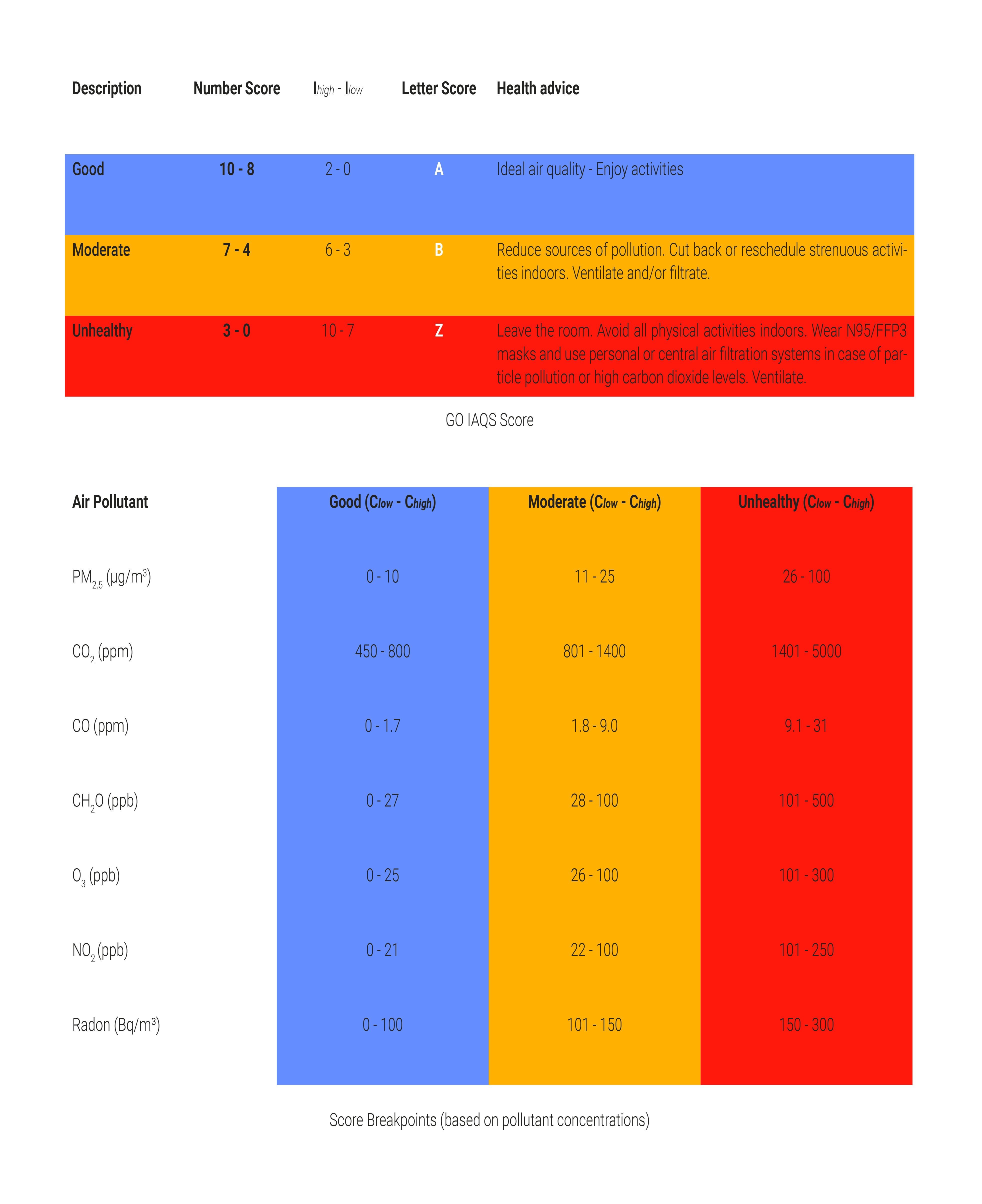
The structure of the score mirrors common educational grading systems, where 10 is the highest achievable score reflecting outstanding performance. This logical design uses a combination of numerical order, color-coding, and simple alphabetical categories: A (Good), B (Moderate), and Z (Unhealthy). This allows users to easily communicate air quality conditions, for example, by saying, “The air indoors is rated B now,” or “The air is Moderate in the classroom.” The use of simple, localizable terms and letters ensures the information is easily shared and understood across diverse languages and cultures.
To align with its health-centric approach, the GO IAQS Score’s three breakpoints are categorized as:
- Good (A): Represents air quality conditions that generally pose minimal risk to public health, though it may not be completely pollution-free.
- Moderate (B): Indicates air quality that may cause minor health concerns, particularly for sensitive individuals (e.g., those with respiratory conditions).
- Unhealthy (Z): Signifies air quality that could adversely affect the health of the entire population.
The simplicity of the score allows people to quickly grasp how safe the air is to breathe, empowering them to make informed decisions about their health and well-being. To ensure maximum accessibility, especially for individuals with color vision deficiency (CVD) that affects as many as 8% of males and 0.5% of females population, GO IAQS undertook a rigorous process involving a CVD AQI Matrix simulation. This process assessed the readability of text and the distinguishability of different index levels across various simulation profiles, paying special attention to the impact of conditions like deuteranomaly.
After analysis, the following HEX Color Codes were selected for the GO IAQS Score as the most suitable choice: Good #648eff; Moderate #ffb000; Unhealthy #ff190c
 GO AQS