
The results presented below are based on a questionnaire distributed to 45 participants from the Advisory Expert Group and Main Committee. The survey, conducted using Google Forms, was open from October 11th to October 23rd, 2024.
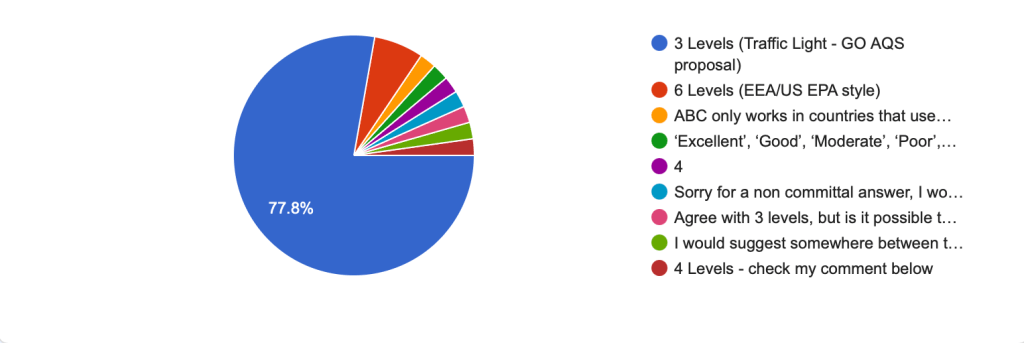
The initial voting on the development of the GO IAQS Indoor Air Quality Index revealed a strong agreement among participants, with a significant majority of 77.8% (n=35) agreeing to adopt the proposed 3-tier system (Traffic Light), aligning with the GO AQS proposal. While this outcome indicates a clear preference for a simplified approach, it is important to acknowledge that a portion of participants suggested exploring a middle ground between the 3-tier and 6-tier systems. A smaller group of 6.7% specifically favored a 6-tier system, drawing parallels to the US EPA and other internationally indices. This diverse range of opinions underscores the need for careful consideration of the potential benefits and drawbacks of different approaches, ultimately aiming to strike a balance between simplicity and comprehensiveness in the final index design.
How many levels or breakpoints should the GO IAQS Indoor Air Quality Index have? We propose 3, do you agree?
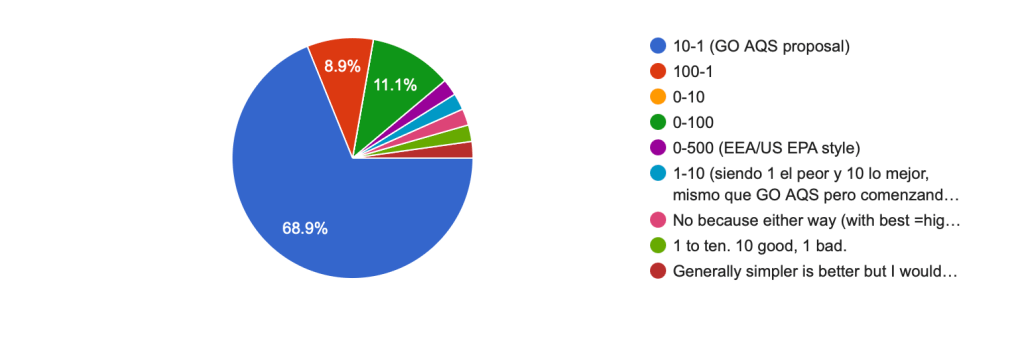
When asked about the preferred numbering scale for the GO IAQS Index, a clear preference for simplicity emerged. A substantial majority of 68.9% (n=31) of participants agreed with the proposed 10-1 scale (10 being the best, 1 being the worst), aligning with the GO AQS proposal. While a smaller portion suggested alternative scales like 0-100 or 100-1, the overall accord leaned towards a more straightforward approach. This finding highlights the importance of keeping the index accessible and easy to understand for the general public.
The GO IAQS Index has a Number Score 10 (Good) to 1 (Bad). Do you agree with this numbering score?
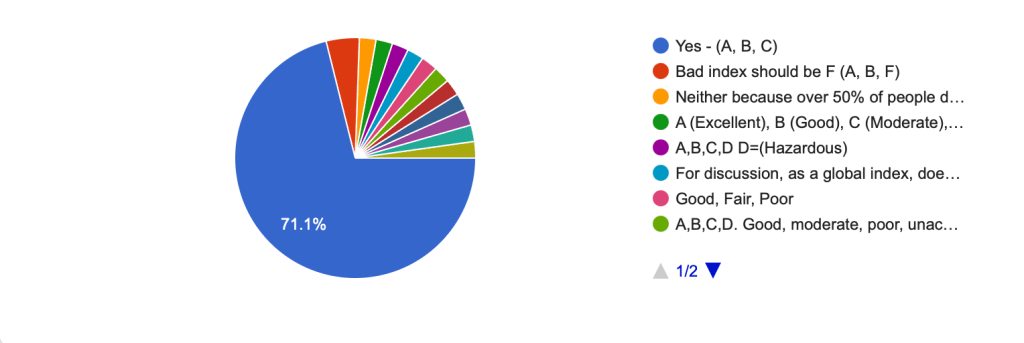
Regarding the proposed letter score for the GO IAQS Index, a significant majority of 71.1% (n=32) of participants expressed agreement with the A, B, C system. This agreement indicates a preference for a simple and easily understandable categorization of air quality levels. However, the remaining responses were more diverse, with various suggestions and considerations. This suggests that while the A, B, C system may be a suitable choice for many, further exploration and refinement may be necessary to ensure optimal clarity and effectiveness for all stakeholders.
The GO AQS Index has a Letter Score: A (Good), B (Moderate), C (Bad). Do you agree with this lettering score?
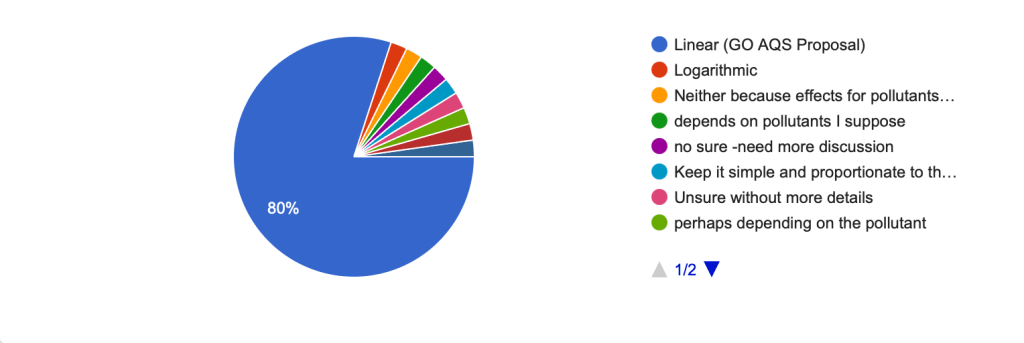
The majority of participants, 80%, (n=36) favored a linear scale for the GO IAQS Index, aligning with the original proposal. This preference stems from the understanding that indoor air pollutant concentrations typically remain within a more manageable range compared to outdoor pollutants like PM2.5, which can reach significantly higher levels. A linear scale effectively reflects the gradual increase in health risks associated with increasing pollutant concentrations in indoor environments, providing a clear and intuitive representation of air quality conditions.
The GO IAQS Index is based on a linear scale. Do you agree or should indoor AQI have a logarithmic scale?
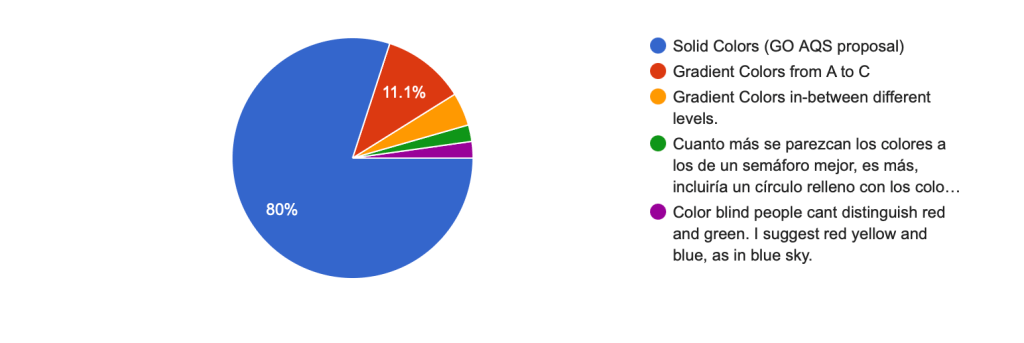
The majority of participants, 80%, (n=36) expressed a preference for solid colors in the GO IAQS Index, aligning with the original proposal. This choice prioritizes clarity and simplicity, making it easier for users to quickly identify air quality levels. While a smaller group of 11.1% suggested using gradient colors from Good to Bad to indicate varying degrees of air quality, the overall agreement leaned towards the use of distinct solid colors. This decision aims to ensure that the index remains user-friendly and easily interpretable for a wide range of individuals.
The GO IAQS Index has solid colors for the different levels. Do you think it needs gradient colors?
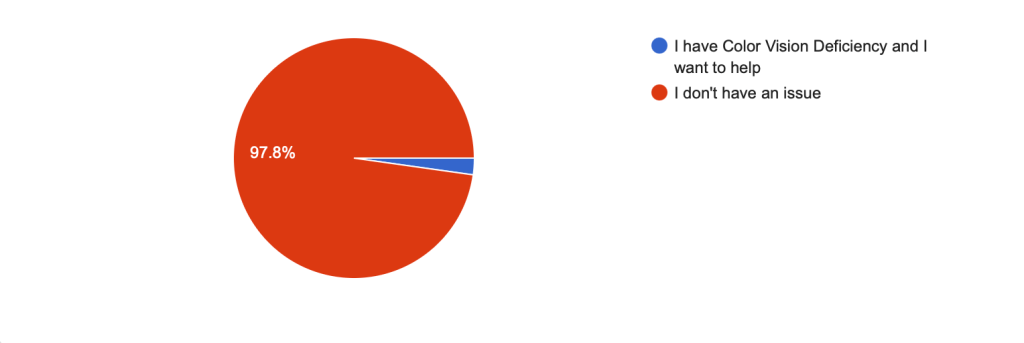
When addressing the potential accessibility issues of the GO IAQS Index for individuals with color vision deficiency, a significant majority of 97.8% (n=44) of respondents reported having normal color vision. However, the survey highlighted the importance of inclusive design by prompting valuable discussions and suggestions. While only one participant directly identified as color blind, numerous respondents (in the open comments) offered helpful resources and insights to better understand the challenges faced by this community. A common suggestion was to replace the color green with blue, as this color combination is often more distinguishable for individuals with color vision deficiencies. By actively seeking feedback and considering alternative approaches, the GO IAQS Index aims to be a tool that is accessible and informative for all.
Currently, the GO IAQS Index has 3 colors, but it came to our attention that people with color vision deficiency have difficulty distinguishing the colors in the index. We want to see if this group has more people that face this issue in order to consult them.
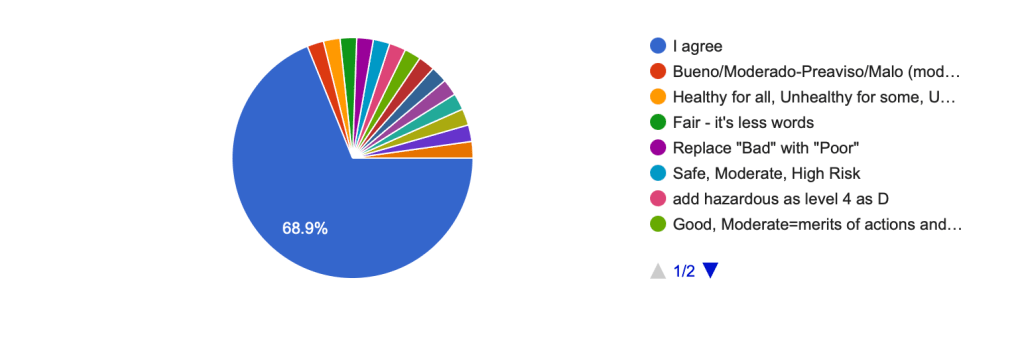
While a majority of 68.9% (n=31) agreed with the proposed wording of “Good, Moderate, and Bad” for the three levels of the GO IAQS Index, a significant portion of respondents suggested alternative phrasing. Some advocated for a more health-centric approach, proposing terms like “Healthy for All,” “Unhealthy for Some,” and “Unhealthy for All.” Others suggested replacing “Bad” with “Poor” or “Unhealthy” to convey a clearer sense of the potential health implications. These diverse perspectives highlight the importance of carefully considering the wording of the index to ensure it effectively communicates the level of risk to public health.
Currently, the 3 levels of the GO IAQS Index are described with the words: Good, Moderate, and Bad. Do you agree with the wording?
Finally, the survey revealed varying opinions on the appropriate weighting of different pollutants in the GO IAQS Index. While the current system assigns equal weight to all pollutants, many experts suggested adjustments. Specifically, there was an agreement that PM2.5 should have a greater weight due to its significant impact on human health. Conversely, CO2 was deemed less critical and should therefore contribute less to the index value. Other pollutants, including particle number (PCN0.3/0.5), ozone, formaldehyde (CH2O), carbon monoxide, nitrogen dioxide, and radon, were generally considered to require increased weighting to accurately reflect their potential health risks. These insights highlight the need for a refinement approach to pollutant weighting and synergistic effects of multiple pollutants, ensuring that the index effectively prioritizes the most harmful substances and provides accurate information to the public.
Next Steps
Based on the valuable feedback received through the 1st GO AQS questionnaire, we are committed to refining the AQ index to better align with user needs and scientific understanding. We will incorporate suggested modifications and categorization, ensuring a more accurate and informative representation of air quality. Additionally, we will enhance the clarity and accessibility of the index, making it easier for individuals to understand and take action based on air quality information. These adjustments will be reflected in an updated white paper and website, providing a comprehensive resource for understanding and improving indoor air quality globally.
 GO AQS
Leave a comment