
The results presented below are based on a questionnaire distributed to 47 participants from the Advisory Expert Group and Main Committee. The survey, conducted using Google Forms, was open from December 4th to December 31st, 2024.
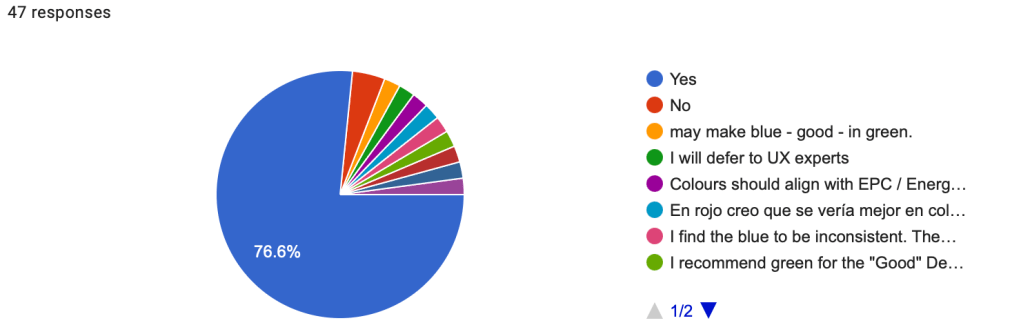
Do you agree with the final GO IAQS Index Colors tailored to people with Color Vision Deficiency?
The 2nd Global Open Air Quality Standards (GO AQS) questionnaire, with 47 participants (n=47), revealed a general consensus regarding the final GO IAQS Index Colors tailored for Color Vision Deficiency. A significant majority (76.6%) agreed with the proposal. While only a small fraction (4.3%) disagreed, several valuable comments were provided. These included suggestions to align colors with EPC/Energy use color themes, concerns about the contrast of black on dark blue (recommending the use of ADA compliance tools), potential confusion with blue representing “good” instead of green, and the perceived inconsistency of the blue color. One participant suggested incorporating the ColorAdd system for symbolic representation to further aid the visually impaired.
Do you agree with the final GO IAQS Number Score from 10 (Good) to 0 (Bad)?
The second question, with 47 participants (n=47), showed strong support for the proposed GO IAQS Number Score from 10 (Good) to 0 (Bad), with 87.2% agreeing. Only 2.1% disagreed, while other feedback focused on alternative scoring methods. Several respondents suggested reversing the scale to have 0 represent good air quality, arguing it is more intuitive. There were also calls for simplifying the scale and a suggestion to use a 0-100 scale, with 100 indicating good air quality.

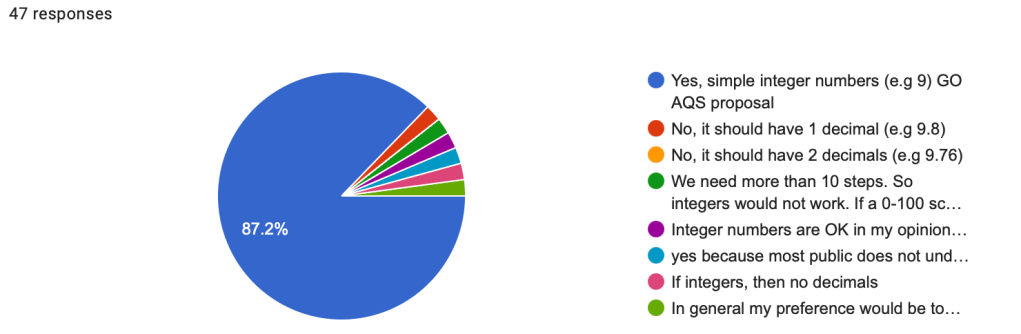
Do you agree with the final GO IAQS Number Score that uses Integer numbers (e.g. 10, 9, 8, 7, etc)?
The third question, with 47 participants (n=47), revealed strong support (87.2%) for using integer numbers (e.g., 10, 9, 8, 7) in the final GO IAQS Number Score. Only two participants disagreed. While some comments acknowledged the simplicity and current functionality of integers, others suggested potential future enhancements. These included adding decimal places for higher resolution, particularly if more than 10 steps are needed, with one suggestion for a 0-100 integer scale. A key argument for using integers was their ease of understanding for the general public, especially considering global variations in decimal notation and the widespread use of the metric system.
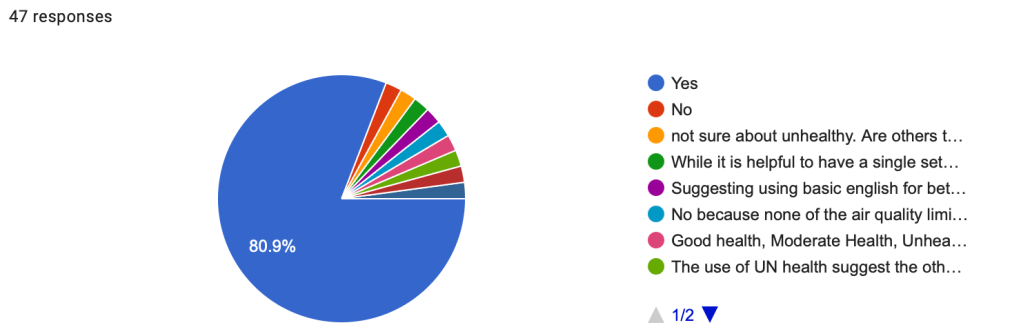
Do you agree with the final GO IAQS description words Good, Moderate, and Unhealthy?
The fourth question, with 47 participants (n=47), showed substantial support (80.9%) for the descriptive words “Good,” “Moderate,” and “Unhealthy” for the final GO IAQS. Only one participant disagreed, but several insightful comments were offered. These included suggestions for alternative phrasing such as “Not good-Good-Enhanced,” “Low Risk, Moderate Risk, High Risk,” “Acceptable, Moderate, Poor,” or “Good health, Moderate Health, Unhealthy,” with arguments that “Poor” or “High Risk” better contrasted with “Good” or “Moderate” than “Unhealthy.” Concerns were raised about the implication that air quality below “Unhealthy” is necessarily “Healthy” or “Good,” and the need to avoid implying that exposures below limits are without adverse effect. Some respondents also advocated for simpler language for non-native English speakers and emphasized the importance of educating users about indoor air quality beyond just using descriptive words, suggesting flexibility in wording based on the target audience.
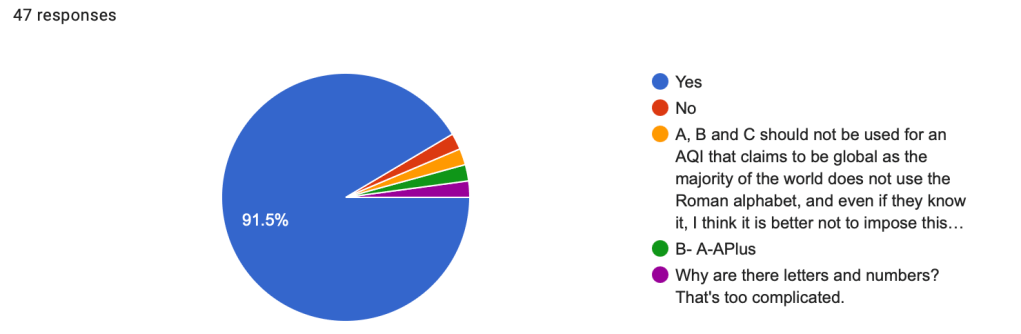
Do you agree with the final GO IAQS Letter Score A, B, and C?
The fifth question, with 47 participants (n=47), revealed substantial agreement (91.5%) with the proposed final GO IAQS Letter Score of A, B, and C. Only one participant disagreed. While some suggested alternative letterings like “B- A-APlus,” key concerns were raised regarding the use of both letters and numbers, which some found overly complex. A prominent point of feedback focused on the global applicability of using Roman letters, given that a majority of the world’s population does not use this alphabet. Some participants suggested eliminating the use of letters entirely for better global comprehension.
Do you agree with the Weight Factors (WF) for the different pollutants that we established during the first voting and the evidence that we share of the white paper v0.11? It is crucial to review the white paper and make sure that the WF is gonna provide valuable information.
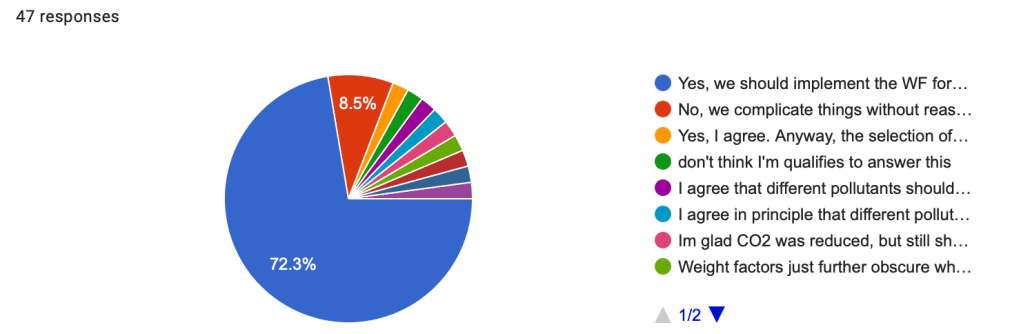
The sixth question of the 2nd questionnaire, concerning agreement with the established Weight Factors (WF) for different pollutants, garnered 72.3% agreement among the 47 participants (n=47). However, a notable 8.5% disagreed, and numerous comments highlighted concerns and alternative perspectives. Several respondents argued against using weight factors altogether, stating that it unnecessarily complicates the system and suggesting that all pollutants should have equal weight or that raw pollutant data should be displayed instead. Others, while agreeing in principle with differentiated weighting, expressed concerns about the magnitude of the differences and the added complexity for seemingly small changes. One participant advocated for providing both weighted and unweighted scores, while another, despite initial doubts, found the preventive nature of the WF acceptable. A specific comment regarding CO2 suggested lowering its weighting further and allowing users to disconnect CO2 readings to align with Perceived Air Methods.
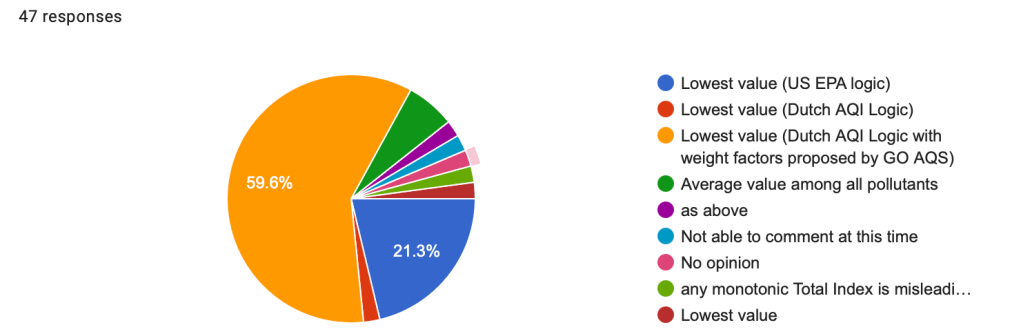
Should the Total Index use the lowest value, average value among the pollutants, or when all pollutants have the same value, the index will be the next lower level in order to compensate for synergetic effects of the pollutants according to Dutch AQI? More info in the white paper v0.11
The 7th question of the questionnaire, concerning the calculation method for the Total Index, revealed divided opinions among the 47 participants (n=47). A majority (59.6%) agreed with using the lowest value, incorporating the Dutch AQI logic and the weight factors proposed by GO AQS. A smaller portion (21.3%) preferred using the lowest value based on US EPA logic. Several participants offered alternative perspectives or expressed indecision, with comments like “Not able to comment at this time” and “No opinion.” One respondent argued against any monotonic Total Index due to the hormetic dose-response curves of certain pollutants like CO and ozone, suggesting instead reporting which pollutants exceed unhealthy levels and perhaps weighting high heat and humidity separately. Another participant suggested using the average value among all pollutants.
Open comments regarding the Index
Participants’ open comments revealed several key themes and suggestions for the GO AQS. Several respondents focused on improving communication of the index, suggesting displaying the predominant pollutant and providing a breakdown of individual pollutants against the Good, Moderate, Unhealthy scale. The concept of a “Moderate” level was questioned, with some proposing it be considered an interim stage rather than a distinct category. The inversion of the typical AQI ranking (higher number being worse) was also queried. Specific feedback on the index colors highlighted the need for clearer text against the color backgrounds. Regarding weight factors, concerns were raised about their potential to obscure information and the seemingly arbitrary nature of some relative weights, suggesting they should be based on published hazard ratios. A strong point was made about the necessity of including a tVOC rating for manufacturer adoption of the GO AQS index. Several participants praised the index’s coverage, pollutant-specific nature, and the use of weight factors, believing it aligns well with other national indices. Technical considerations were also raised, including the need to account for PM LCS technology accuracy, particularly for values under 5 μg/m3. One participant suggested a more detailed historical context for air quality limits in the white paper and proposed several options for establishing exposure limits. The potential inconsistencies arising from comparing the GO IAQS index with individual pollutant values across different averaging intervals were highlighted, suggesting field testing the index on devices. A call for a fourth, “Hazardous” level beyond “Unhealthy” was made, emphasizing the need for immediate avoidance and action at that level. Finally, one participant expressed continued reservations about the use of blue instead of green in the color scheme, while acknowledging the importance of inclusivity.
Additional Questions
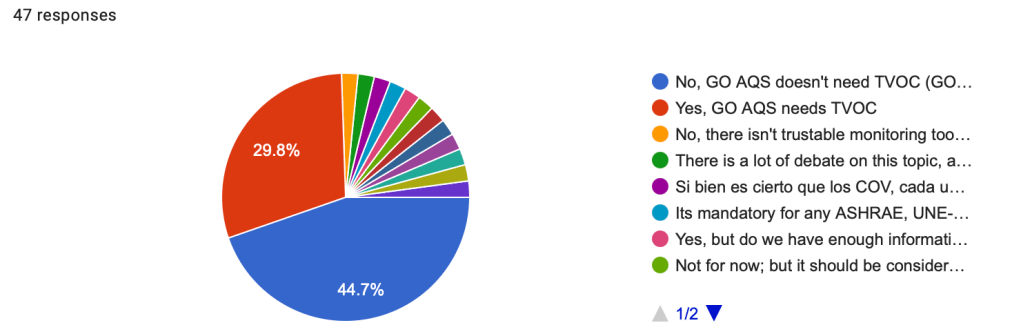
A couple of people have expressed their interest in TVOC limits and inclusion in the GO IAQS Index. Do you see value on such parameter? We have already establish an answer on page 13.
Outside the direct scope of index development, the question of including TVOCs in the GO IAQS Index generated varied responses crucial for future planning. While 44.7% of participants supported the GO AQS proposal of excluding TVOCs, 29.8% believed it should be included. The remaining comments highlighted the complexities and challenges associated with TVOC measurement and interpretation. Several participants acknowledged TVOC’s commonness in monitoring but emphasized its unreliability and lack of clear health-based standards. Some suggested focusing on specific VOCs with known health risks, like formaldehyde, instead. Others pointed to the necessity of TVOC measurements in established building standards like ASHRAE, WELL, and LEED, while stressing the importance of prior lab certification for IAQ monitors. Concerns were raised about the lack of standardization in VOC sensors and their varying responses to gas mixtures, as well as the limitations of LCS MOx technology for accurate TVOC measurements. A recurring theme was the need for more reliable and standardized TVOC monitoring technologies and calibration methods before considering its inclusion in the GO IAQS Index.
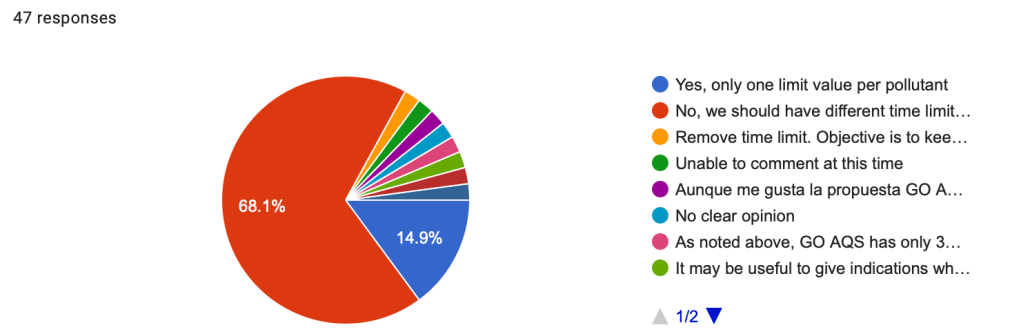
There was a suggestion instead of having limits for different time average 1h, 8h, 24h, and 1year to have one limit per pollutant. Do you agree?
Regarding the question of time-averaged limits for pollutants, a significant majority (68.1%) of participants supported the GO AQS proposal of maintaining different time limits (1h, 8h, 24h, 1 year) to represent diverse indoor environments. Only 14.9% advocated for a single limit per pollutant. The remaining comments emphasized the importance of time frames in defining pollutant limits, arguing that a number without a time context is meaningless, effectively implying a ceiling limit. One participant suggested removing time limits altogether, aiming for continuous good air quality rather than adherence to specific time-based thresholds. Another noted the widespread misunderstanding of time-weighted averages (TWA) versus ceiling limits, with many treating any limit as a ceiling. Finally, one participant suggested indicating whether limits are health-based or not.
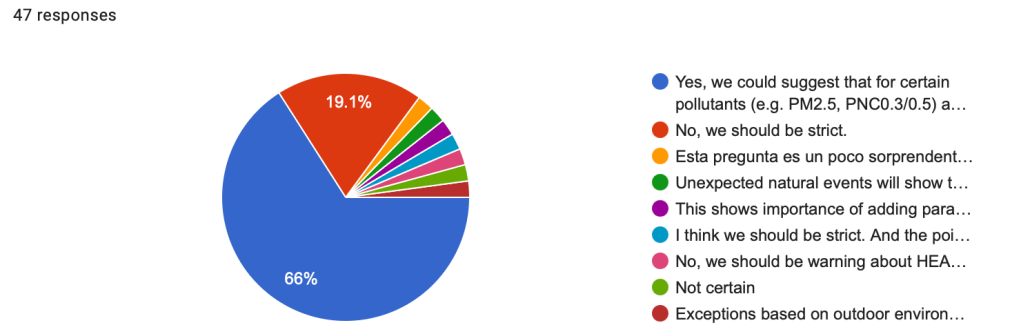
Due to unexpected natural events in the outdoor environment (wildfires, dust storms, etc.), there was a suggestion to include exception dates that will allow buildings to comply with the standard when limits are breached for a small period of time; e.g. 5 days exception for PM2.5 if outdoors there are such natural events.
Regarding the suggestion of including exception dates for Green Building compliance during unexpected natural events like wildfires or dust storms, a significant majority (66%) of participants agreed that such exceptions could be considered for specific pollutants (e.g., PM2.5, PNC0.3/0.5) and for short durations. They viewed this as an important step for Green Building adoption. A smaller portion (19.1%) advocated for strict adherence to standards regardless of external events. Other comments presented different perspectives. Some argued that natural events expose building IAQ weaknesses and that proper recording and justification of breaches are sufficient for Green Building adoption. Others suggested that while exceptions might be viable, they should acknowledge and reward buildings with advanced filtration systems that mitigate the impact of such events. A key counterargument was that the focus should remain on warning about health risks, not simply on compliance.
General open comments
The participants raised several important points for consideration. There’s debate about exceptions for natural disasters impacting outdoor air quality, with some advocating for stricter adherence to limits and others suggesting temporary allowances. Health concerns surrounding formaldehyde were highlighted with a call to reference the EPA’s recent report. Additionally, concerns raised about the language used for extreme condition exceptions, emphasizing the need for clear communication and potential social equity issues. Finally, there’s discussion about the overall approach to setting air quality limits, with some advocating for adopting the world’s most stringent standards and others suggesting a balance between strictness and encouraging adoption. These considerations underline the complexity of establishing effective indoor air quality guidelines.
Next Steps
In response to valuable feedback received through the 2nd GO AQS questionnaire, we are undertaking a refinement of the AQ Index. This will involve incorporating suggested modifications and a revised categorization system to ensure a more accurate and informative reflection of air quality. The upcoming white paper will incorporate some of these improvements.
 GO AQS
Leave a comment