
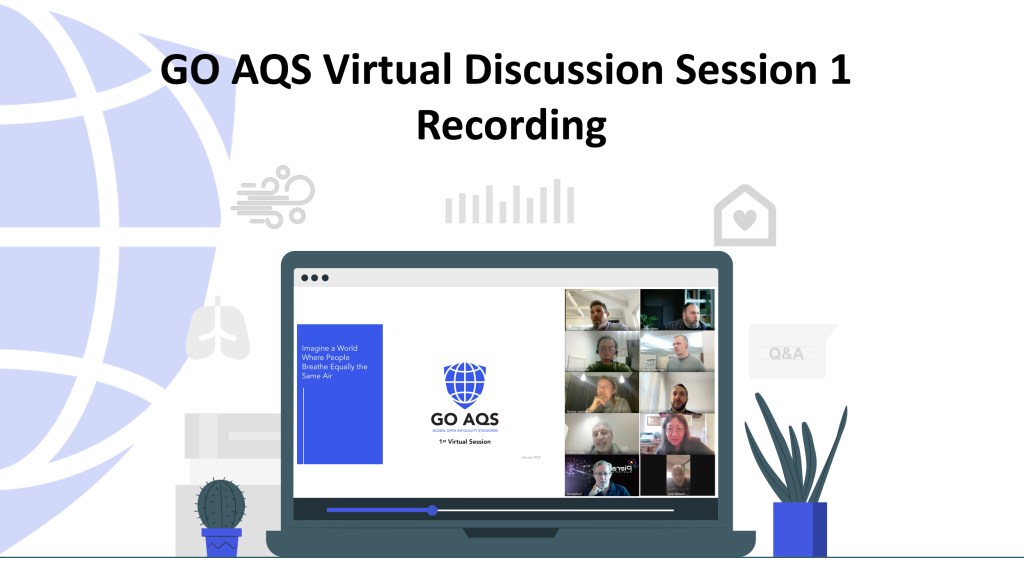
The GO AQS Virtual Discussion Session 1 was held on January 15, 2025 to discuss updates and feedback on the development of the GO AQS index and more. The session began with updates from the Main Committee, including progress on the white paper, discussions with green building certificate programs, and upcoming events. The majority of the session was dedicated to a discussion of the proposed GO AQS index.
Index Development Feedback
One of the main topics of discussion was the color scheme for the index. Some participants questioned why green was not used to represent good air quality. The organizers explained that they wanted to be inclusive, as 8% of the male population and 0.5% of the female population are colorblind to green. Instead, blue was chosen to represent good air quality, as it is easily associated with a blue sky.
Another point of discussion was the numbering system for the index. Some participants suggested using a scale of 0 to 100, with 0 representing good air quality and 100 representing unhealthy air quality. However, the GO AQS team believes that 0 should represent the worst air quality, as it is associated with failure in education and finance. Therefore, the GO AQS index will use a scale of 0 to 10, with 10 representing the best air quality. Integer numbers will be used to avoid confusion. Finally, some participants preferred assigning a value of 1, rather than 0, to the worst air quality, a change that would not align with the current index calculation formula.
The language used to describe air quality was also discussed. Some participants suggested using terms like “low risk” and “high risk” to communicate air quality levels. However, concerns were raised that this language might give the wrong message, as there is always some risk associated with air quality. Other suggestions included using “acceptable” instead of “good” and “poor” instead of “unhealthy.” The GO AQS team is open to considering alternative language, but they want to ensure that the language is clear and easy to understand for everyone.
The use of letters to describe air quality was also discussed. Currently, the GO AQS index uses letters A, B, and C to represent different air quality levels. Some participants suggested using letters A, B, C, and F, with F representing a failing grade. However, others argued that letters are too complicated and could be difficult for people in countries that don’t use the Latin alphabet to understand. GO AQS is considering removing letter representations from its Index. While the original intention was to finalize the standard and translate the letters into other languages to accommodate non-Latin alphabets, this approach may be abandoned.
Weight Factors
The use of weight factors for different pollutants was also a topic of discussion. Weight factors are used to account for the fact that some pollutants have a greater impact on human health than others. For example, PM2.5 has been shown to have a significant impact on human health, so it is given a higher weight factor than other pollutants. The Weight Factors discussion elicited no feedback from the attendees. This suggests that simplifying the index by removing Weight Factors may be a more appropriate approach.
TVOCs
The inclusion of total volatile organic compounds (TVOCs) in the index was another major point of discussion. TVOCs are a group of chemicals that can be released from a variety of sources, including building materials, furniture, and cleaning products. Many participants expressed concerns about the reliability and consistency of TVOC sensors. Different sensors can produce different readings, even when measuring the same air sample. Additionally, the specific VOCs that are measured by a TVOC sensor can vary depending on the sensor technology and the manufacturer. This makes it difficult to develop a standardized approach to measuring and reporting TVOC levels.
Participants suggested various approaches for addressing the challenges of TVOC measurement and reporting, including:
- Compromise and Transparency: Acknowledging the limitations of TVOC sensors in the standard, recommending further investigation if high levels are detected, and focusing on the longitudinal picture of chemicals they provide.
- Focus on Trends: Using TVOC measurements to track relative changes in VOC levels over time, rather than relying on absolute values.
- Data Fusion: Combining TVOC data with other sensor readings, such as particle counts, to improve readability.
Working Groups
To address the complexity of the index development, the GO AQS team proposed the formation of working groups focused on specific pollutants and aspects of indoor air quality. The proposed working groups include:
- Particulate Matter (including PM2.5 and PCN)
- Carbon Dioxide
- Ozone
- Carbon Monoxide
- Formaldehyde
- Nitrogen Dioxide
- Radon
- Ventilation
- Filtration
These groups would allow experts to focus on specific areas and streamline the development process. To ensure coordination, information would be shared through the white paper, the GO AQS website, blog posts, and meeting minutes. The session concluded with a reminder that the GO AQS standard is an evolving document that will be updated over time. The team expressed their appreciation for the participants’ contributions and emphasized the importance of collaboration in achieving their goal of creating a comprehensive and effective indoor air quality standard.
Webinar Recording 39 min

 GO AQS
Leave a comment