
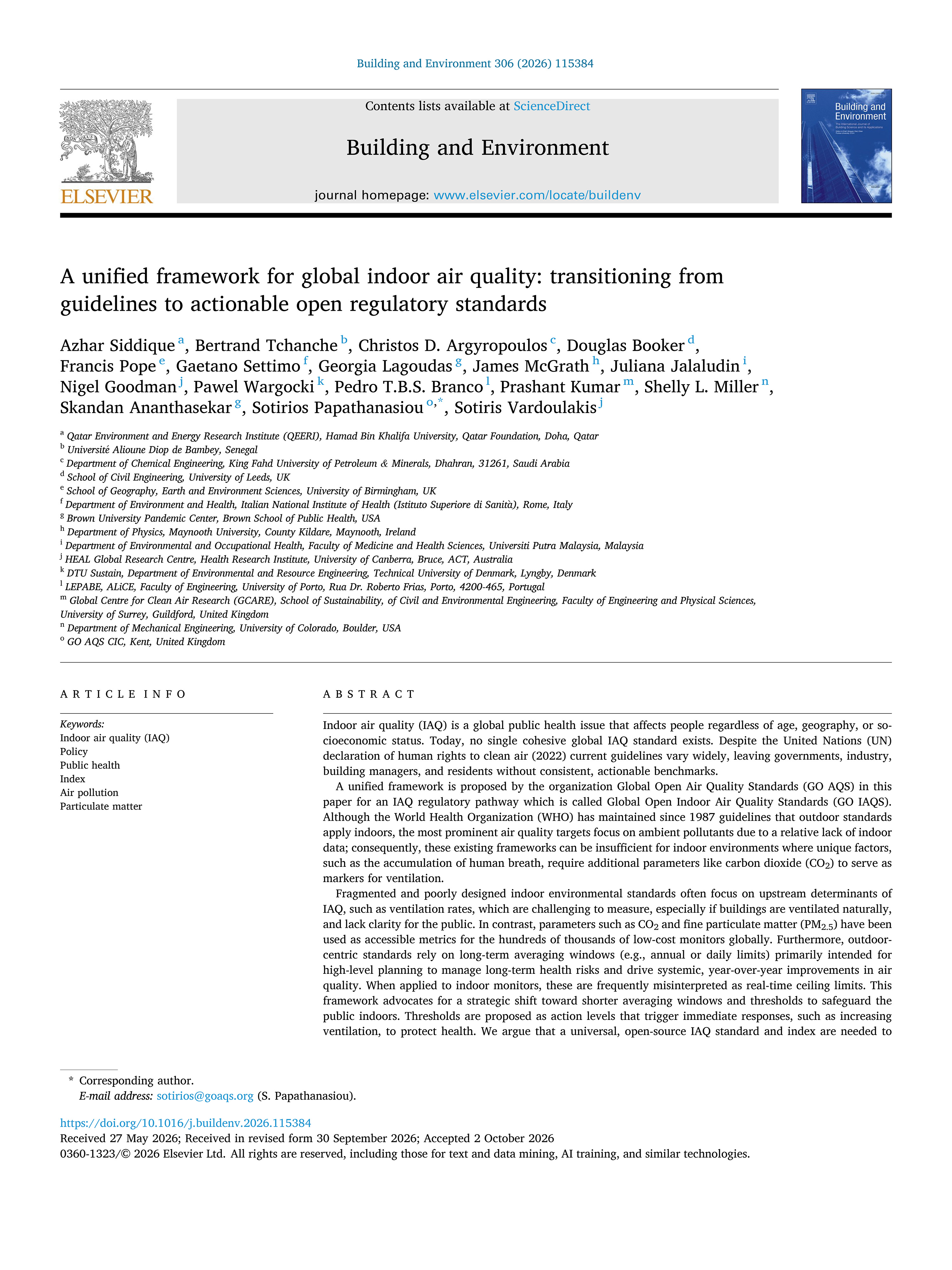
We are thrilled to announce a pivotal milestone for the Global Open Indoor Air Quality Standards (GO IAQS): our foundational paper, titled “A unified framework for global indoor air quality: transitioning from guidelines to actionable open regulatory standards,” has officially been published in the prestigious journal Building and Environment (DOI: 10.1016/j.buildenv.2026.115384).
This landmark publication marks a critical step forward in our mission to revolutionize how indoor air quality (IAQ) is measured, regulated, and managed globally.
Validating Open, Fair, and Actionable Air Quality Standards
For too long, indoor air quality standards have suffered from fragmentation, closed ecosystems, or complex guidelines that are difficult to translate into enforceable, safe environments. GO AQS was founded on a simple yet transformative belief: air quality standards must be open, fair, clear, and protective for all.
Passing the rigorous peer-review process of Building and Environment provides robust academic validation of the framework we have been building alongside our community. It underscores that transitioning from passive guidelines to actionable, open regulatory standards is not only necessary, it is scientifically sound and globally imperative.
“This publication provides important validation of the work we have been doing with the incredible support of our community. By uniting scientific rigor with open standards, we are paving the way toward healthier indoor environments accessible to everyone.”
Driven by World-Class Expertise
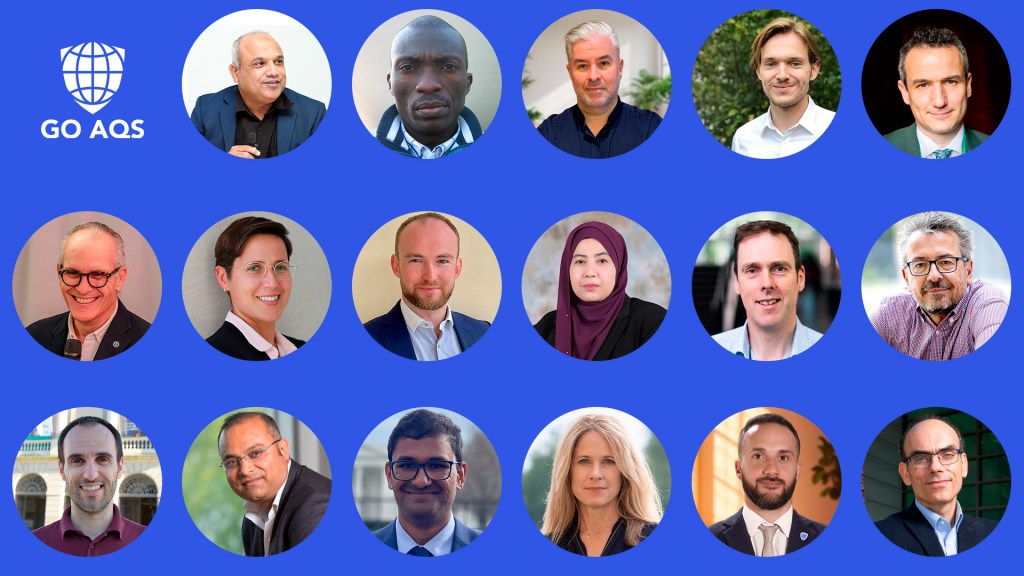
This achievement was made possible through the collaboration and dedication of 17 distinguished academics and IAQ experts from across the globe. Listed alphabetically in the paper, their contributions reflect a shared commitment to elevating indoor health standards through multidisciplinary rigor:
(Alphabetical order as presented in the publication)
- Azhar Siddique — Qatar Environment and Energy Research Institute (QEERI), Hamad Bin Khalifa University, Qatar Foundation, Doha, Qatar
- Bertrand Tchanche — Université Alioune Diop de Bambey, Senegal
- Christos D. Argyropoulos — Department of Chemical Engineering, King Fahd University of Petroleum & Minerals, Dhahran, Saudi Arabia
- Douglas Booker — School of Civil Engineering, University of Leeds, UK
- Francis Pope — School of Geography, Earth and Environmental Sciences, University of Birmingham, UK
- Gaetano Settimo — Department of Environment and Health, Italian National Institute of Health (Istituto Superiore di Sanità), Rome, Italy
- Georgia Lagoudas — Brown University Pandemic Center, Brown School of Public Health, USA
- James McGrath — Department of Physics, Maynooth University, County Kildare, Maynooth, Ireland
- Juliana Jalaludin — Department of Environmental and Occupational Health, Faculty of Medicine and Health Sciences, Universiti Putra Malaysia, Malaysia
- Nigel Goodman — HEAL Global Research Centre, Health Research Institute, University of Canberra, Bruce, ACT, Australia
- Pawel Wargocki — DTU Sustain, Department of Environmental and Resource Engineering, Technical University of Denmark, Lyngby, Denmark
- Pedro T.B.S. Branco — LEPABE, ALICE, Faculty of Engineering, University of Porto, Porto, Portugal
- Prashant Kumar — Global Centre for Clean Air Research (GCARE), School of Sustainability, Civil and Environmental Engineering, Faculty of Engineering and Physical Sciences, University of Surrey, Guildford, United Kingdom
- Shelly L. Miller — Department of Mechanical Engineering, University of Colorado, Boulder, USA
- Skandan Ananthasekar — Brown University Pandemic Center, Brown School of Public Health, USA
- Sotirios Papathanasiou — GO AQS CIC, Kent, United Kingdom
- Sotiris Vardoulakis — HEAL Global Research Centre, Health Research Institute, University of Canberra, Bruce, ACT, Australia
We extend our deepest gratitude to every co-author and reviewer whose insights helped refine this framework through the peer-review process.
What’s Next for GO AQS?
With this publication establishing our theoretical and scientific foundation, GO AQS is moving at full momentum to accelerate practical adoption.
As we look ahead, we will continue working alongside researchers, industry leaders, policymakers, and community advocates to translate this unified framework into real-world impact. Together, we can ensure that clean, healthy indoor air becomes a universal, standard right.
- Read the paper online at Building and Environment: DOI Link


Leave a Reply