
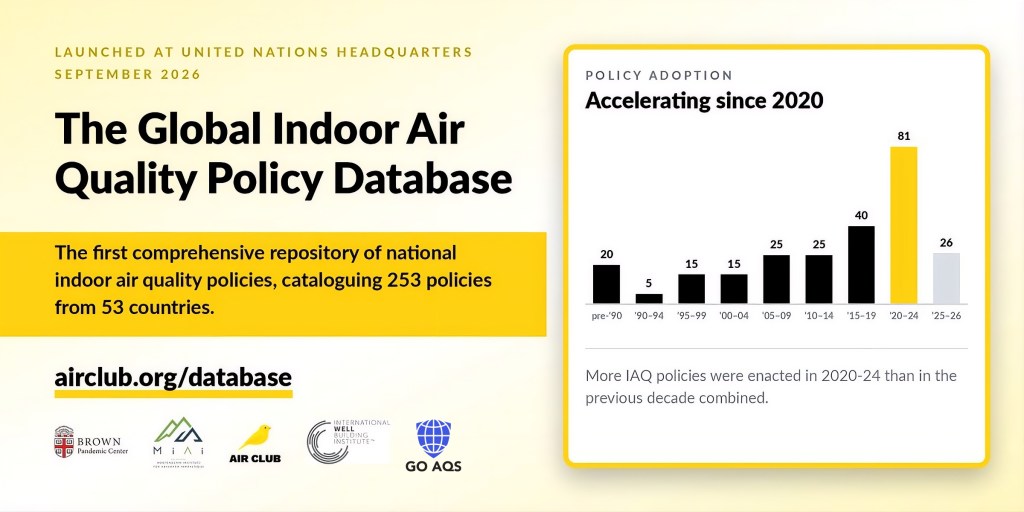
As world leaders and climate experts gather in New York for the United Nations General Assembly and Climate Week, a major milestone in public health and environmental governance has been unveiled: the release of the Global Indoor Air Quality Policy Database.
Developed through a global collaborative effort involving the Air Club, the Brown University Pandemic Center, the Montenegrin Institute for Advanced Innovation, GO AQS, and IWBI, this repository represents the first comprehensive global mapping of indoor air quality (IAQ) governance.
Why This Database Matters
People spend up to 90% of their lives indoors, yet indoor air quality has historically remained an invisible, under-regulated public health domain. The Global IAQ Policy Database addresses this gap by cataloging 253 policies across 53 countries, offering policymakers, researchers, and building industry experts an unprecedented tool to track, evaluate, and learn from indoor air policies worldwide.
Key Features of the Platform:
- Comprehensive Policy Registry: An interactive index of regulations, national standards, building codes, and health guidelines categorized by country, domain, and legal mechanism.
- Country Leadership Profiles: Detailed profiles of 17 pioneering nations, mapping out their governance frameworks, enforcement mechanisms, and monitoring regimes.
- IAQ Policy Maturity Framework: A multi-dimensional diagnostic tool enabling nations to self-assess their progress across five core criteria: central coordination, monitoring, health-based standards, enforcement, and implementation support.
Key Findings: A Turning Point for Indoor Air Policy
The initial findings published alongside Version 1.0 of the database reveal both significant momentum and crucial areas where action is urgently needed:
- A Post-2020 Surge: 42% of all recorded policies have been enacted since 2020, driven by heightened global awareness of airborne pathogen transmission, wildfire smoke, and climate resilience.
- Fragmented Responsibility: Only 15% of surveyed countries (8 out of 53) have a dedicated, single government agency leading IAQ policy. In most regions, oversight remains split across health, environment, energy, housing, and labor departments.
- Gaps in Key Settings: While workplace safety regulations account for a large portion of binding laws, high-density public environments, such as schools and educational facilities, remain largely uncovered by enforceable indoor air standards.
GO AQS & Global Collaboration
As a contributor to this milestone initiative, GO AQS joined forces with international research centers, public health advocates, and building science authorities to help compile, structure, and refine this vital policy data. By bringing together open data principles, standardizations, and regulatory evidence, the coalition aims to give leaders a practical roadmap to establish clean, healthy indoor air as a standard human right.
Explore the Resource
The database is open to the public and welcomes ongoing contributions from global researchers, institutions, and policy experts as new regulations emerge.
- Explore the Database: https://airclub.org/database
- Citation: Brown University Pandemic Center & Air Club. (2026). Global Indoor Air Quality Policy Database (Version 1.0).


Leave a comment