
At GO AQS, we firmly embrace technology because it grants us the power to see what is otherwise invisible: the continuous, shifting dynamics of the air we breathe.
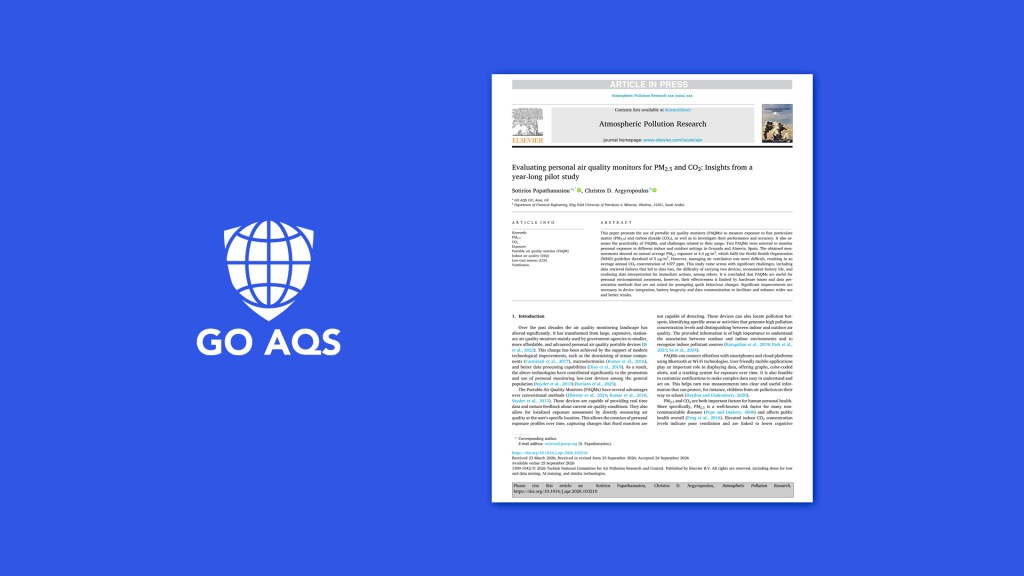
We are excited to share that our research paper, titled “Evaluating personal air quality monitors for PM2.5 and CO2: Insights from a year-long pilot study,” has been officially published in Atmospheric Pollution Research (DOI: 10.1016/j.apr.2026.103210).
Here is a brief overview of our journey and what drove this study.
The Year-Long Study
Our pilot study ran for a full 367 days, spanning from mid-summer 2024 to mid-summer 2025. We deliberately carried two portable air quality monitors with us everywhere we went to experience all seasonal changes and daily environmental challenges.
While device technology continues to evolve, carrying these monitors every day taught us a tremendous amount about human exposure and the practical realities of personal air monitoring.
Key Highlights
- Balancing Ventilation and Filtration: We uncovered a natural tension between keeping outdoor particulate matter out through filtration and keeping indoor carbon dioxide levels low through fresh air ventilation.
- Hardware Usability: Carrying devices continuously highlighted real-world friction points, such as battery management, data synchronization, and ergonomics.
- Actionable Data: The study emphasized that air quality data needs to be clear and proactive so users can make immediate decisions rather than reviewing past averages.
We encourage anyone interested in low-cost sensors, personal exposure, and indoor air quality to read the full published paper for all the underlying data, methodologies, and findings.
Read the full paper at Atmospheric Pollution Research via DOI 10.1016/j.apr.2026.103210.
A big thank you to Prof. Christos D. Argyropoulos, co-author of the paper, for his guidance and commitment to advancing the air quality field.


Leave a comment